

The story crypto media tells itself is that AI search killed its traffic. Zero-click answers absorb the query, the reader never lands on the page, and the publisher eats the loss. It’s a clean narrative, and it’s the wrong diagnosis for most of what actually happened.
ICODA’s two-year traffic analysis of 40 crypto news domains splits the “AI killed us” narrative into three separate events, and only one of them is about AI. Getting the diagnosis right matters, because each of the three has a different fix. Treating a de-indexing problem as an AI-visibility problem means fixing the wrong thing.
The Narrative Rests on Four Domains
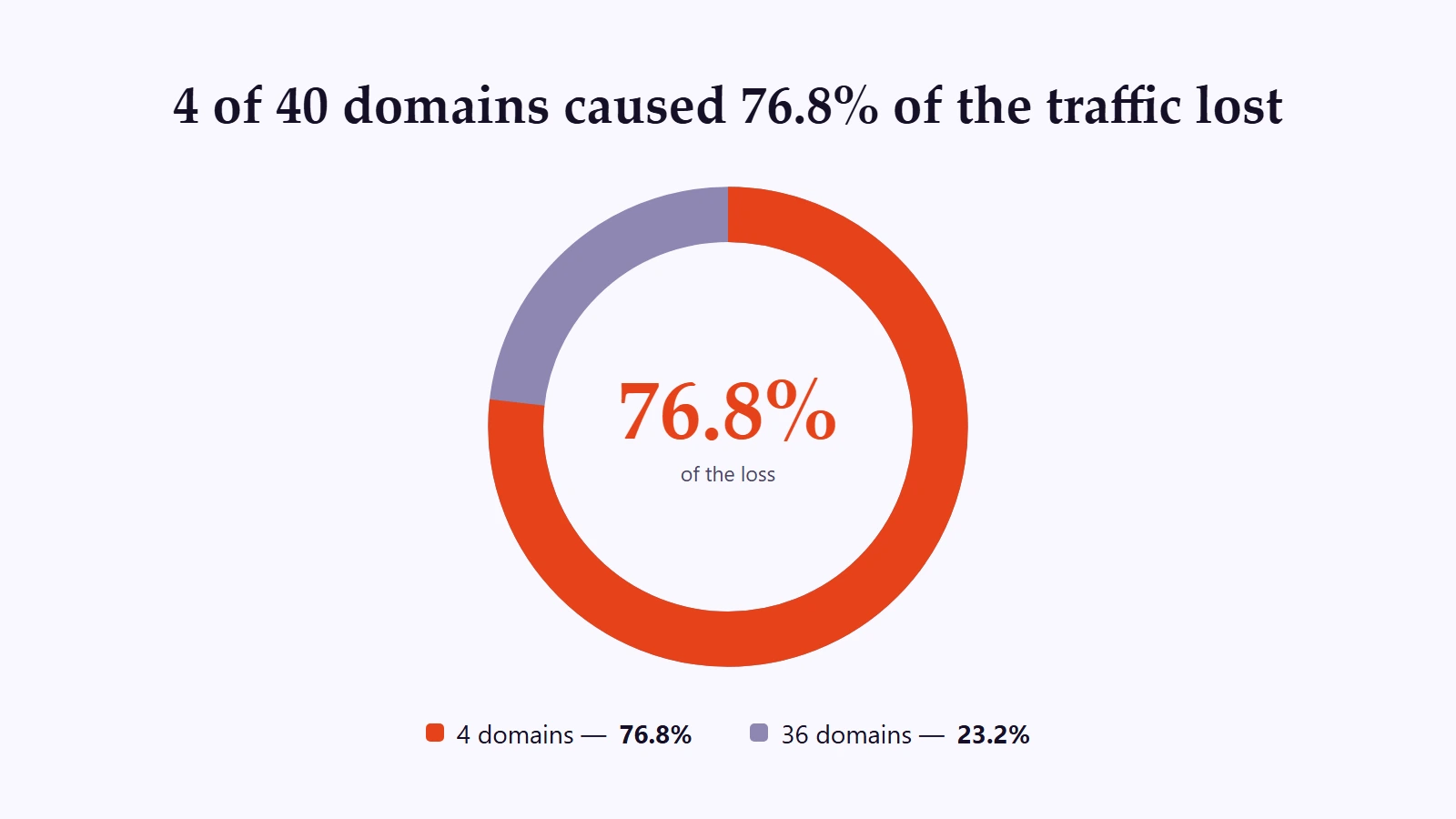
Aggregate organic traffic across the 40-domain sample fell 37.2% year over year, from Q2 2025 to Q2 2026. That number is the one that gets quoted. It’s also almost entirely produced by four domains: Cointelegraph, U.Today, DL News, and Unchained.
Those four account for 76.8% of the category’s entire traffic loss, while holding under 30% of the category’s traffic at the start of the period. Strip them out, and the remaining 36 domains fell a combined 12.2%, a materially different story than “crypto media is collapsing.”
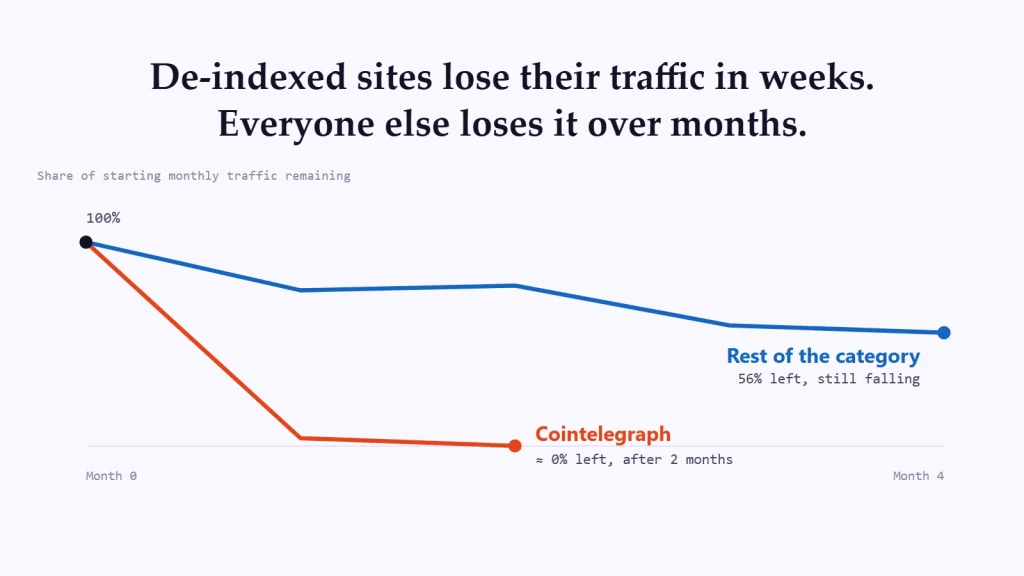
The four collapse cases don’t look like AI compression. They look like on/off switches. Cointelegraph went from 2.04 million monthly visits in October 2025 to 79,347 in November to 2,310 in December, and sits at 18 today. U.Today fell from 651,022 monthly visits in June 2025 to 6,476 in August. These are step functions: a site present in the index one month and functionally absent the next. Rising zero-click behavior produces a slope. It does not produce a cliff.
ICODA’s citation data confirms the distinction directly. Cointelegraph, at severe traffic destruction, holds zero citations across Google’s AI Overviews, AI Mode, and Gemini combined, a total absence that tracks with de-indexation, not a ranking demotion. DL News, which lost 99% of its organic traffic over the same window (374,651 monthly visits down to 4,091), retains 52 AI Overviews citations, 78 in AI Mode, and 35 in Gemini. Both charts show the same collapse. The citation data shows opposite conditions: one domain is still indexed and citable and simply stopped ranking; the other has been removed from the candidate pool for AI answers entirely, because that pool is drawn from the same index that dropped it.
Four domains, one shared signature. It isn’t AI adoption. It’s enforcement.
The Real Decline Is Real, and It’s Four Months Old
Removing the collapse cases doesn’t clear AI search of everything. It relocates the evidence to somewhere far more specific.
For the 33 domains with no collapse event and no relaunch artifact, traffic held in a normal range through most of 2025, oscillating between roughly 14 million and 21.5 million monthly visits across the category, tracking crypto news cycles up and down, the way it always had. Then, starting in March 2026, it simply falls: 13.41 million, 10.25 million, 10.56 million, 7.94 million, 7.46 million. The median domain in this clean cohort lost 47.7% between March and July 2026, and 28 of 33 declined.
That window lines up with Google’s consolidation of AI Overviews and AI Mode into a single surface, and it’s not unique to crypto. Comparable Semrush figures reported by the Wall Street Journal over the same period show roughly −50% at USA Today, −25% at CNN, −23% at Politico, and more than −85% at Business Insider. Crypto media is absorbing the same zero-click compression hitting general news, layered on top of the enforcement losses that are specific to the category.
Why the Distinction Is the Whole Point
A publisher reading “AI is killing crypto media” reaches for an AI-visibility fix: optimize for citation, restructure content for retrieval, chase AI Overviews. That’s the right fix for exactly one of the three things in this data: the ordinary, gradual compression that started in March. It does nothing for a domain that’s been removed from the index outright, because de-indexed content isn’t a candidate for AI citation in the first place; it’s not in the pool being drawn from.
The three components, and what each one requires:
Conflating these three into one “AI killed us” story means a publisher fighting for reinstatement wastes effort on retrieval optimization, while a publisher losing share to zero-click behavior wastes effort chasing a de-indexing appeal that was never their problem.
The Diagnostic That Separates Them
The fastest way to tell which of the three a domain is dealing with: check its AI citation count against its traffic chart, not against the aggregate narrative. A domain with a traffic cliff and zero AI citations across Google’s surfaces is de-indexed. A domain with a traffic slope and a normal citation count is absorbing zero-click compression. A domain gaining share of voice across news cycles is neither, and doesn’t need either fix.
The category-wide number, down 37.2%, is true and almost useless on its own, because it describes four outlier domains and thirty-six ordinary ones as if they had the same problem. They didn’t, and the fix for one does nothing for the other.
Methodology note: figures are drawn from ICODA’s original study of 40 crypto news and editorial domains, using Ahrefs organic-traffic data (June 2024 to July 2026) and AI citation counts across six platforms (Google’s AI Overviews, AI Mode, Gemini; independent ChatGPT, Perplexity, Grok), snapshotted 10 August 2026. Cohort labels are inferred from decline shape and citation state and are interpretive; traffic decline alone cannot distinguish a penalty from a ranking loss, a migration, or falling demand. Full methodology, limitations, and dataset available in the complete report.